
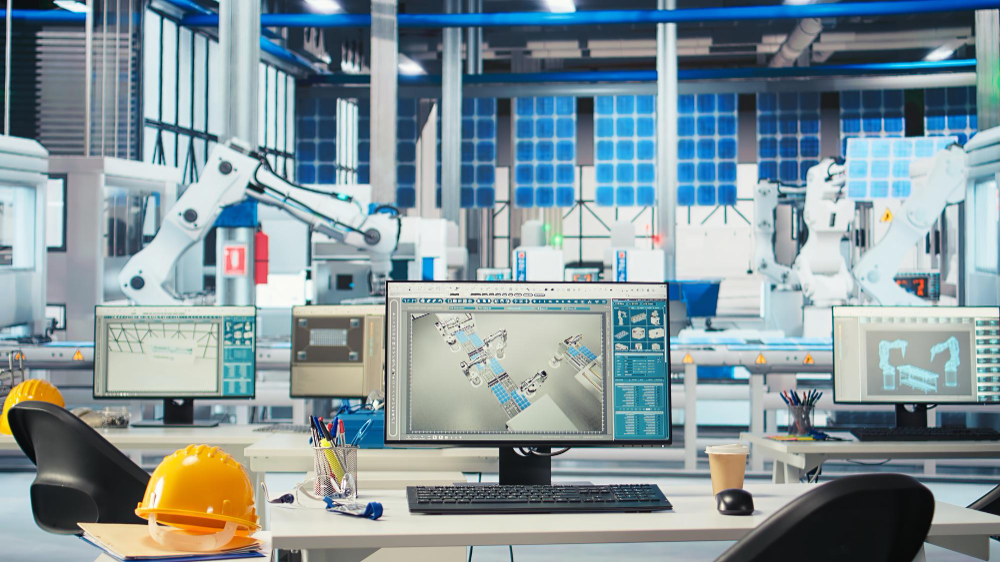
Industry 4.0 and Digital Transformation In India
India stands at the forefront of a new industrial era driven by Industry 4.0 and rapid digital transformation. Industry 4.0, often referred to as the Fourth Industrial Revolution, integrates cutting-edge technologies like Artificial Intelligence (AI), the Internet of Things (IoT), Robotics, Big Data, and Cloud Computing into manufacturing and business operations. In India, this digital shift is reshaping traditional industries, boosting productivity, and creating smarter, more efficient systems.
With strong government initiatives such as Digital India, Make in India, and SAMARTH Udyog Bharat 4.0, the country is actively promoting the adoption of smart technologies across sectors. As businesses and startups embrace automation and data-driven processes, India is not just adapting to global standards but is emerging as a leader in digital innovation and sustainable industrial growth.
What Is Industry 4.0?
Industry 4.0, also known as the Fourth Industrial Revolution, represents the convergence of cyber-physical systems, IoT (Internet of Things), AI, robotics, big data analytics, and cloud computing into manufacturing and production. Over the last decade, India has embraced this transformation, especially in sectors like manufacturing, IT, agriculture, logistics, and public services.
Key Technologies Driving the Fourth Industrial Revolution
Artificial Intelligence (AI) & Machine Learning
Artificial Intelligence (AI) and Machine Learning (ML) are technologies that enable computers and machines to perform tasks that normally require human intelligence. These systems can analyze data, learn from patterns, and make decisions or predictions without being explicitly programmed every time. Like AI can power voice assistants, detect fraud, recommend products, or control self-driving cars.
Machine Learning is a subset of AI that focuses on teaching machines how to improve their performance automatically through experience. They are the backbone of many smart applications used in Industry 4.0.
Internet of Things (IoT)
The Internet of Things (IoT) refers to a network of physical devices such as sensors, appliances, vehicles, and machines that are connected to the internet and can collect, share, and exchange data in real time. These smart devices communicate with each other and with centralized systems, enabling automation, remote monitoring, and data-driven decision-making across various sectors like healthcare, agriculture, manufacturing, and smart homes.
Big Data & Analytics
Big Data & Analytics refers to the process of collecting, managing, and analyzing extremely large and complex datasets that traditional data processing tools can't handle efficiently. By using advanced tools and technologies, it helps organizations uncover patterns, trends, and insights from data—enabling better decision-making, forecasting, and personalized experiences. It's widely used in fields like marketing, healthcare, finance, and manufacturing to drive efficiency, innovation, and competitive advantage.
3D Printing & Additive Manufacturing
3D Printing & Additive Manufacturing has gained significant traction in India over the past decade, especially among startups and innovation hubs. This technology has found impactful applications in healthcare (like customized implants and prosthetics), aerospace (for lightweight, complex components), and rapid prototyping across industries. It has helped reduce production costs, shorten design-to-market cycles, and enabled localized manufacturing, making it a vital part of India’s Industry 4.0 transformation.
Automation & Robotics
In India, the adoption of automation and robotics has been gradually increasing, particularly in sectors like automobile, textile, and FMCG. These industries are integrating robots for tasks such as assembly line operations, packaging, material handling, and quality control to boost efficiency and reduce human error. Large enterprises are leading the way, growing awareness and cost-effective solutions are encouraging mid-sized firms to explore automation as a means to stay competitive in the global market.
Developments Of Digital Transformations (Year-wise Highlights)
2015–2018: Laying the Digital Foundation
Launched in 2015, the Digital India Mission aimed to transform India into a digitally empowered society and knowledge economy by focusing on digital infrastructure, e-governance, and universal digital literacy. Around the same time, the government introduced Smart City projects to develop urban areas with technology-driven infrastructure and services.
Complementing these efforts, the Make in India initiative was launched to boost manufacturing and encourage the adoption of smart technologies across industries, laying the foundation for India’s journey into Industry 4.0.
2018–2020: Early Adoption Phase
Between 2018 and 2020, Indian MSMEs began adopting automation to improve efficiency and reduce operational costs. This period also saw the initiation of 5G trials in India, laying the technological foundation for smart manufacturing through faster and more reliable connectivity.
Together, key sectors like pharmaceuticals, logistics, and automotive started integrating IoT and AI tools to enhance production, streamline supply chains, and enable predictive maintenance, marking a crucial step toward Industry 4.0 adoption.
2020–2022: COVID-19 Acceleration
The COVID-19 pandemic significantly accelerated digital transformation across industries in India. Companies rapidly adopted digital tools to enable remote work, ensure business continuity, and maintain operations amid lockdowns. This shift led to a surge in sectors like e-commerce, telemedicine, and edtech, as consumers increasingly relied on digital platforms. Organizations also prioritized cloud adoption and strengthened cybersecurity infrastructure to support distributed teams and protect sensitive data.
2023–2025: Maturity & Integration
Since the 2023 rollout of 5G in India, industries have seen a major leap in real-time automation, especially in manufacturing. The enhanced connectivity has enabled the integration of smart technologies like drones, robotics, and AI in sectors such as agriculture and warehousing. At the same time, the government’s Production Linked Incentive (PLI) schemes have actively encouraged the adoption of advanced technologies in manufacturing.
India’s Initiatives on Digital Transformation
India has launched several key initiatives to accelerate digital transformation across sectors. These initiatives aim to promote technology-driven governance, industrial innovation, and digital inclusion.
Some of the major efforts include:
1. Digital India
Launched in 2015, Digital India is a flagship initiative aimed at transforming the country into a digitally empowered society and knowledge-based economy. It focuses on building strong digital infrastructure, expanding mobile and internet connectivity, promoting digital literacy, and ensuring the efficient delivery of government services through e-Governance platforms.
2. Make in India
Make in India, launched in 2014, is a major initiative by the Indian government aimed at boosting domestic manufacturing and attracting global investment. While its primary focus is on enhancing industrial production, the initiative also emphasizes the adoption of advanced technologies such as automation, robotics, and data analytics. By encouraging smart manufacturing practices and fostering innovation, Make in India aims to modernize traditional industries, improve productivity, and position Indian manufacturing as globally competitive in the era of Industry 4.0.
3. Startup India & Standup India
Programs like Startup India and Standup India are designed to foster innovation and entrepreneurship, especially in the digital and technology sectors. They provide a supportive ecosystem through simplified business registration processes, tax exemptions, funding support, and access to incubation centers. These initiatives aim to empower young entrepreneurs, promote job creation, and drive digital innovation across industries in India.
4. SAMARTH Udyog Bharat 4.0
SAMARTH Udyog Bharat 4.0 is a government initiative led by the Ministry of Heavy Industries to promote the adoption of Industry 4.0 technologies across India's manufacturing sector. The program focuses on establishing Centers of Excellence to support and demonstrate advanced technologies such as automation, IoT, AI, and data analytics. It plays a crucial role in helping MSMEs (Micro, Small, and Medium Enterprises) upgrade their processes, improve productivity, and stay competitive in the global market by embracing smart manufacturing practices.
5. National Policy on Electronics (NPE) 2019
The National Policy on Electronics (NPE) 2019 aims to position India as a global hub for Electronics System Design and Manufacturing (ESDM). It focuses on promoting domestic manufacturing, attracting investment, and strengthening India's capabilities in high-tech areas such as Artificial Intelligence (AI), robotics, and semiconductors. Creating a supportive ecosystem for innovation, research, and skilled workforce development, the policy seeks to boost self-reliance and global competitiveness in the electronics sector.
6. BharatNet
BharatNet is a nationwide initiative aimed at providing high-speed internet connectivity to rural and remote areas of India. By connecting over 2.5 lakh gram panchayats through an extensive optical fiber network, the program seeks to bridge the digital divide and promote inclusive growth. With improved internet access, BharatNet enables a range of services such as e-learning, telemedicine, digital banking, and online governance, empowering rural communities with opportunities for education, healthcare, and economic development.
7. Unified Payments Interface (UPI) & Digital Payments Push
India has transformed its digital economy through the widespread adoption of platforms like Unified Payments Interface (UPI), Aadhaar-enabled payment systems (AEPS), and mobile wallets. These innovations have simplified financial transactions, making them fast, secure, and accessible even in remote areas. UPI, in particular, has become a global model for real-time payments, enabling seamless peer-to-peer and business transactions.
8. Smart Cities Mission
The Smart Cities Mission was launched to modernize urban infrastructure by leveraging advanced digital technologies such as the Internet of Things (IoT), smart sensors, and data analytics. The goal is to enhance the quality of life in cities by improving public services, streamlining traffic management, ensuring better waste and water management, and enabling efficient urban planning. Integrating technology into the core functioning of cities, the mission aims to create sustainable, citizen-friendly urban environments.
Final View On Industry 4.0 and Digital Transformation
Industry 4.0 represents more than just a technology upgrade it marks a fundamental shift in how businesses operate by breaking down silos and connecting teams and processes across the manufacturing landscape. This integrated approach fosters greater transparency and a holistic way of working that can extend across the entire organization. With improved resource allocation, reduced downtime, and increased productivity, operational efficiency is significantly enhanced.
These gains also support sustainability efforts, as smart automation and analytics help optimize energy use, minimize waste, and enable the design of more eco-friendly products. Digital transformation is not a one-time event but a continuous journey. It offers a roadmap from assessment to long-term leadership, turning challenges into opportunities for growth, resilience, and innovation. By embracing agility, adopting emerging technologies, and cultivating a digital-first mindset, organizations can future-proof their operations and drive sustainable, inclusive progress one step at a time.
FAQs
Q1: What is Industry 4.0?
A: Industry 4.0 is the integration of advanced technologies like IoT, automation, and data analytics to create smarter, more connected manufacturing and business processes.
Q2: How does Industry 4.0 improve operational efficiency?
A: It enhances efficiency by improving resource allocation, reducing downtime, increasing productivity, and streamlining workflows.
Q3: Can Industry 4.0 support sustainability?
A: Yes, it helps optimize energy use, reduce waste, and design eco-friendly products through smart automation and data-driven insights.
Q4: Is digital transformation a one-time process?
A: No, digital transformation is a continuous journey that evolves with technology and business needs.
Q5: How can businesses prepare for digital transformation?
A: By embracing agility, adopting emerging technologies, and fostering a digital-first culture, businesses can stay competitive and drive long-term growth.
Interesting Reads:
Advanced Manufacturing Technologies